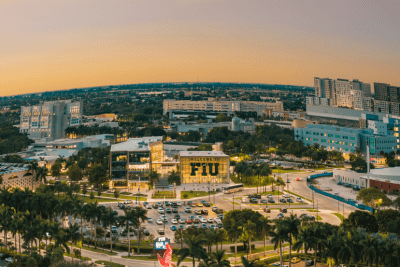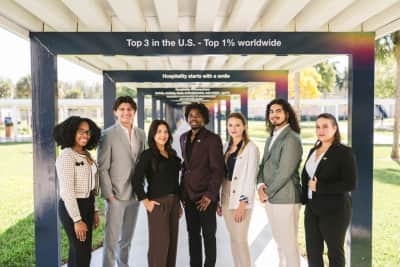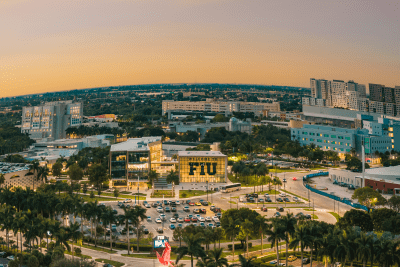
Florida International University - Miami's public research university - is one of America's most dynamic institutions of higher learning. Since opening in 1972, FIU has achieved many benchmarks of excellence that have taken other universities more than a century to reach. The University has a nationally renowned full-time faculty, known for their outstanding teaching and cutting edge research; students from throughout the U.S. and more than 130 foreign countries; and its alumni have risen to prominence in every field and are a testament to the University's academic excellence. A member of the State University System of Florida, FIU is a research university offering a diverse selection of undergraduate, graduate and professional programs. Through its 16 colleges and schools, FIU offers more than 180 baccalaureate, master's, and doctoral degree programs in more than 280 majors, conducts basic and applied research, and provides public service. Committed to both quality and access, FIU meets the educational needs of traditional students as well as the increasing number of part-time students and lifelong learners. Interdisciplinary centers and institutes at the University conduct research and teaching that address economic and social concerns. FIU
currently has more than 32,000 students, 1,100 full-time faculty and 90,000
alumni, making it the largest public university in South Florida. FIU
has been ranked among the top 100 public national universities in the
U.S. News & World Report annual guide to "America's Best
Colleges." FIU was the youngest institution in the group. The magazine
has reported that FIU students are among the least indebted college students
in the nation and recognized the University as a "best buy"
in higher education. In 1998, Kiplinger's Personal Finance Magazine
ranked FIU as the country's 18th best value in public higher education.
FIU was named one of the top 10 public commuter colleges in the U.S. in
the 1995 edition of Money Guide, an annual report published by
Money magazine, and has been cited in several other of the country's
leading college guides. FIU is a member of Phi Beta Kappa, the country's
oldest and most distinguished academic honor society.
FIU was established by the Florida legislature in 1965. Classes began in September 1972, with 5,667 students enrolled in upper-division and graduate programs, the largest opening day enrollment in the history of American higher education. In 1981, the University added lower-division classes for freshmen and sophomores, expanding its enrollment capacity. In 1984, the University received authority to begin offering degree programs at the doctoral level; these programs received Level IV accreditation from the Southern Association of Colleges and Schools (SACS) in 1986. In 1994, the Carnegie Foundation for the Advancement of Teaching classified FIU as a Doctoral I University, and in 2000 it reclassified the University as a Doctoral/Research University-Extensive, the highest ranking in the organization's prestigious classification system. The
Florida Board of Regents appointed Charles E. Perry as the first president
of FIU in 1969. He was succeeded in January 1976 by Harold B. Crosby.
Gregory B. Wolfe was named the third president in February 1979. Modesto
A. Maidique, the fourth and current president, was appointed to his position
in August 1986.
School
of Accounting
In addition to the University's academic departments, interdisciplinary centers, institutes and special programs conduct advanced research in a wide range of areas. Many centers and institutes receive national and international recognition for their outstanding work. Academy
for the Art of Teaching
In fall 2000, enrollment was 32,387, which includes students from almost all 50 states and more than 130 foreign countries. The student body is a microcosm of the diverse Miami community, with nearly 70 percent of student enrollment from minority groups: 51 percent Hispanic, 15 percent black, and 3.5 percent Asian. Approximately 7.6 percent of enrollment is comprised of international students.
Since opening in 1972, the University has conferred more than 100,000 degrees to some 90,000 graduates. The Office of Alumni Affairs sponsors alumni programs, including professional advancement, fund raising and social events, and communicates with alumni through the FIU Magazine, newsletters and special mailings. Membership in the FIU Alumni Association, which is led by a volunteer board of alumni leaders, is open to all graduates, spouses and friends of the University and includes a wide variety of benefits.
FIU has two major campuses, University Park in western Miami-Dade County and the Biscayne Bay Campus in North Miami. It also has two academic sites that serve Broward County, in Davie and downtown Fort Lauderdale. Architecturally distinctive University Park, FIU's first campus and administrative headquarters, occupies 342 acres of lush tropical landscaped grounds. Apartment style and traditional residence halls, the Golden Panther Sports Arena, a new state-of- the-art eight-story Library, an environmental preserve and other athletic facilities contribute to a pleasant collegiate atmosphere. The 40-acre Center for Engineering and Applied Science, a major research facility, is located near University Park. The Biscayne Bay Campus encompasses nearly 200 acres, including a natural mangrove preserve. Its scenic campus offers direct access to the bay, apartment- style housing, a library, an aquatic center, and the Roz and Cal Kovens Conference Center, a state-of-the-art facility that can accommodate up to 500 persons. The
FIU Broward site in Davie emphasizes undergraduate programs. In cooperation
with Broward Community College (BCC), there is a "2+2" program
in which students enroll in BCC for the firs t two years of study and
complete their degree at FIU. The Rubin O'D. Askew University Tower, in
downtown Fort Lauderdale, is primarily utilized for master's and doctoral
programs, research and administrative offices.
The University's 1999-2000 operating budget is $400 million. FIU has 2,800 full-time employees. The University has an economic impact of more than $1.4 billion on the South Florida economy. FIU has a total of 4,500 employees, placing it among Miami-Dade County's 20 largest employers.
Florida International University emphasizes research as a major component of its mission. Sponsored research funding from outside sources grew more than five-fold over the last decade, from $10.2 million in 1989-90 to $58.1 million in 1999-2000. These funds, secured through contracts and grants from private foundations, corporations, and federal and state agencies, are used to conduct research, provide stipends for graduate students and improve research facilities. Notable centers of excellence include: Biomedical Engineering Institute: The institute, operated in conjunction with the Miami Cardiac & Vascular Institute at Baptist and South Miami Hospitals, conducts significant interdisciplinary biomedical research; leads academia-clinical-industry partnerships in biotechnology development; and delivers education and training. Areas of concentration include: biomedical instrumentation and devices; computer modeling; cardiovascular experimental modeling; cardiovascular biomaterials and biocompatibility; blood flow analysis; nuclear imaging and diagnostics; and ultrasound technology. Computer Science: The FIU High Performance Database Research Center conducts research on database management systems. It is developing new methods of using databases, including parallel computing where a large number of processors simultaneously work on database tasks. Government agencies and industries, including NASA, the National Science Foundation, U.S. Department of Defense and U.S. Department of the Interior support the center's research. Hemispheric Center for Environmental Technology: Established in 1995 by the University in partnership with the U.S. Department of Energy, the center researches, develops and demonstrates innovative environmental technologies and facilitates their transfer to commercial and government users. As a testing center, HCET is an international leader in the evaluation and demonstration of new technology for decontaminating and decommissioning of nuclear facilities. International Hurricane Center: Established in 1996, the IHC - the only university-based hurricane research center in the country - conducts research to help reduce the damage hurricanes inflict on people, the economy, and the environment. The IHC takes advantage of its proximity to and relationship with the National Hurricane Center, which is located on FIU's University Park campus. Latin
American and Caribbean Center (LACC): Recognized as one of the finest
programs of its type in the world, the center conducts interdisciplinary
programs in undergraduate and graduate studies, faculty research, public
education and public service. One of LACC's programs is the Summit of
the Americas Center, was created by the state of Florida in 1995, is monitoring
the accords reached at the historic 1994 Public Health: The department conducted the South Beach Health Survey, a survey to identify the prevalence of HIV infection and the risk factors and behaviors associated with HIV infection. It is now planning a community-based project to eliminate health disparities in the African American and Hispanic populations in Broward County, with an emphasis on reducing the incidence of HIV infection and AIDS. Southeast Environmental Research Center: The center conducts basic and applied research on the myriad environmental challenges confronting South Florida -- from Lake Okeechobee south to the Florida Keys -- with an emphasis on the Everglades. The results of its research reveal solutions for problems and steps to prevent future degeneration. The program houses the offices of two federal agencies also working to restore the South Florida ecosystem: the U.S. Geological Survey - Biological Research Division and the South Florida Ecosystem Restoration Task Force. Tropical Biology: Combining expertise from the departments of Biological Sciences, Geology and Environmental Studies, as well as the Southeast Environmental Research Center, the United States Geological Service Biotic Resource Division and Fairchild Tropical Garden, the program embraces one of the largest concentrations of tropical biologists in the United States. Faculty participating in the program have broad research interests that are explored in tropical oceans, wetlands, and terrestrial habitats. The Wolfsonian-FIU: Located in the heart of Miami Beach's Art Deco District, The Wolfsonian-FIU is a world-class museum that promotes the collection, preservation and understanding of decorative art and design of modernity from the period 1885-1945. Through
exhibitions and public programs, The Wolfsonian-FIU investigates the ways
in which design shapes and reflects human experience. Assembled by Mitchell
Wolfson Jr., its collection includes more than 70,000 objects, predominantly
from North America and Europe, providing rich evidence of the cultural,
political and technological changes that swept the world in the century
preceding World War II. The Wolfsonian Research Center hosts visiting
scholars from the U.S. and abroad.
The University Park Library and Biscayne Bay Campus Libraries have a combined collection of more than 1.5 million volumes, in addition to substantial holdings of federal, state, local and international documents, periodicals, maps, microfilms, institutional archives and curriculum materials. The library subscribes to approximately 9,700 journals and serials and offers a wide variety of on-line resources. The
library has the resources to locate and access holdings at other major
libraries throughout the state and country. Its on-line computer catalog,
LUIS (Library User Information Service), provides information on the collections
of all libraries of the State University System of Florida. It also offers
electronic access to databases on a variety of subjects. The Wolfsonian-FIU,
which has an extensive collection of rare books
Tuition and fees are established by the State University System Board of Regents. 2000-01 credit hour fees* are: Undergraduate
Graduate Annual estimated costs for undergraduates (30 credits+fees) are $2,335 for Florida residents and $9,673 for Florida non-residents. Graduate costs (24 credits+fees) are $3,722 for Florida residents and $12,812 for Florida non-residents. *
All costs are subject to change without notice
Financial aid in the form of grants, scholarships, assistantships, fellowships, loans and work-study is awarded on the basis of academic achievement and/or financial need. During
the 1998-99 academic year, $71.2 million in financial aid was disbursed
among more than 32,000 awards. Funds distributed included $22.6 million
in grants, $37 million in loans, $10.6 million in scholarships and $896,000
for work-study positions.
Student housing is available at both University Park and Biscayne Bay Campus in apartment style accommodations ranging from one-person studios to eight-person suites. Each campus housing complex is designed to accommodate married students and small families as well as single students. Several units are adapted for use by handicapped students. While one-person studio apartments are available, the typical units are designed for two or four students and contain a small kitchen, a private bath, bedrooms and a living/ dining area. Housing at University Park can accomodate more than 1,500 students, while the complex at Biscayne Bay Campus houses 425 students in five different apartment styles. The University offers food service in cafeterias on both campuses.
Students
can take advantage of a diverse range of social and cultural events on
and off campus. University organizations sponsor concerts, films, plays,
lectures, ethnic festivals and other special events during the year. Students
have opportunities to participate in student government, clubs, fraternities,
sororities and honor societies. The South Florida community offers a tremendous
variety of recreational activities,
FIU's intercollegiate athletic teams compete in the National Collegiate Athletic Association (NCAA) Division I, the nation's most competitive college sports division, and the Sun Belt Conference. Fifteen sports programs are offered: women's programs consist of basketball, cross country, golf, soccer, softball, tennis, indoor and outdoor track and field and volleyball; and the men's program includes baseball, basketball, cross country, soccer, and indoor and outdoor track and field. In 2002, FIU will be launching its first intercollegiate football program, with its team competing in Division I-AA. The University's primary sports facilities include the Golden Panther Arena, a building that seats 4,500, the FIU Community Stadium (which is being expanded to accommodate 18,000 fans for football), and lighted baseball and soccer fields. The
University also has programs in eight intramural sports: bowling, basketball,
flag football, golf, soccer, softball, softball and volleyball. Fitness
centers at both University Park and North Campus are equipped with a complete
line of Nautilus and Universal equipment and free weights. The Aquatic
Center at North Campus features an Olympic-sized pool and diving well.
Modesto
A. Maidique Mark
B. Rosenberg Paul
D. Gallagher Gwendolyn
V. Boyd Thomas
A. Breslin Patricia
Telles-Irvin Dale
Chapman Webb
Admissions
348-2363
University
Park Campus Biscayne
Bay Campus Broward
- University Tower Broward
BCC The
Metropolitan Center The
Wolfsonian-FIU 7.01 |
||||||||||||||||||||||